
I want to tell you what nobody puts on the box, because I bought Grandpa's Feeders expecting it to be the last feeder I ever carried out to the coop, and for a while the honest truth is that it was the most frustrating thing I owned that winter. I am Rosie. I keep about a dozen hens in rural Missouri alongside two horses and two rescue dogs, and I had been feeding out of a tray for a year when the nightly rustle in the shavings and the fine layer of cracked corn tracked across the floor every morning finally pushed me over the edge. The feeder fixed the waste, I will not argue with that. But it did it in a way that cost me a week of fiddling, a session with an Allen key I had to track down, and a few moments where I genuinely wondered if I had bought the wrong thing.
This is the honest review of Grandpa's Feeders 20 lb treadle feeder, written after close to a year of daily use. I am not going to rehearse the marketing line back at you. You already know it is supposed to be rat-proof and low-waste. I am here to tell you what actually happens when the box is open, when the lid will not quite close, when a heavy bird perches on top of the hopper, and whether the whole thing is worth the current price for a flock the size of yours.
The Quick Verdict
A genuinely effective waste and rodent stopper once it is tuned, but it is not plug-and-play: you will spend a weekend on the counterweight and the lid, and it is overkill unless you keep six or more birds.
Amazon Check Today's Price →If you are already committed to the treadle, this is the one most people land on. Just budget a weekend for the tuning.
Grandpa's Feeders 20 lb treadle feeder is the workhorse of the rat-proof category. The steel is heavy, the design is proven, and once your flock learns it, the feed stays shut to everything but a hen's foot.
Amazon Check Today's Price on Amazon →How I've Used It
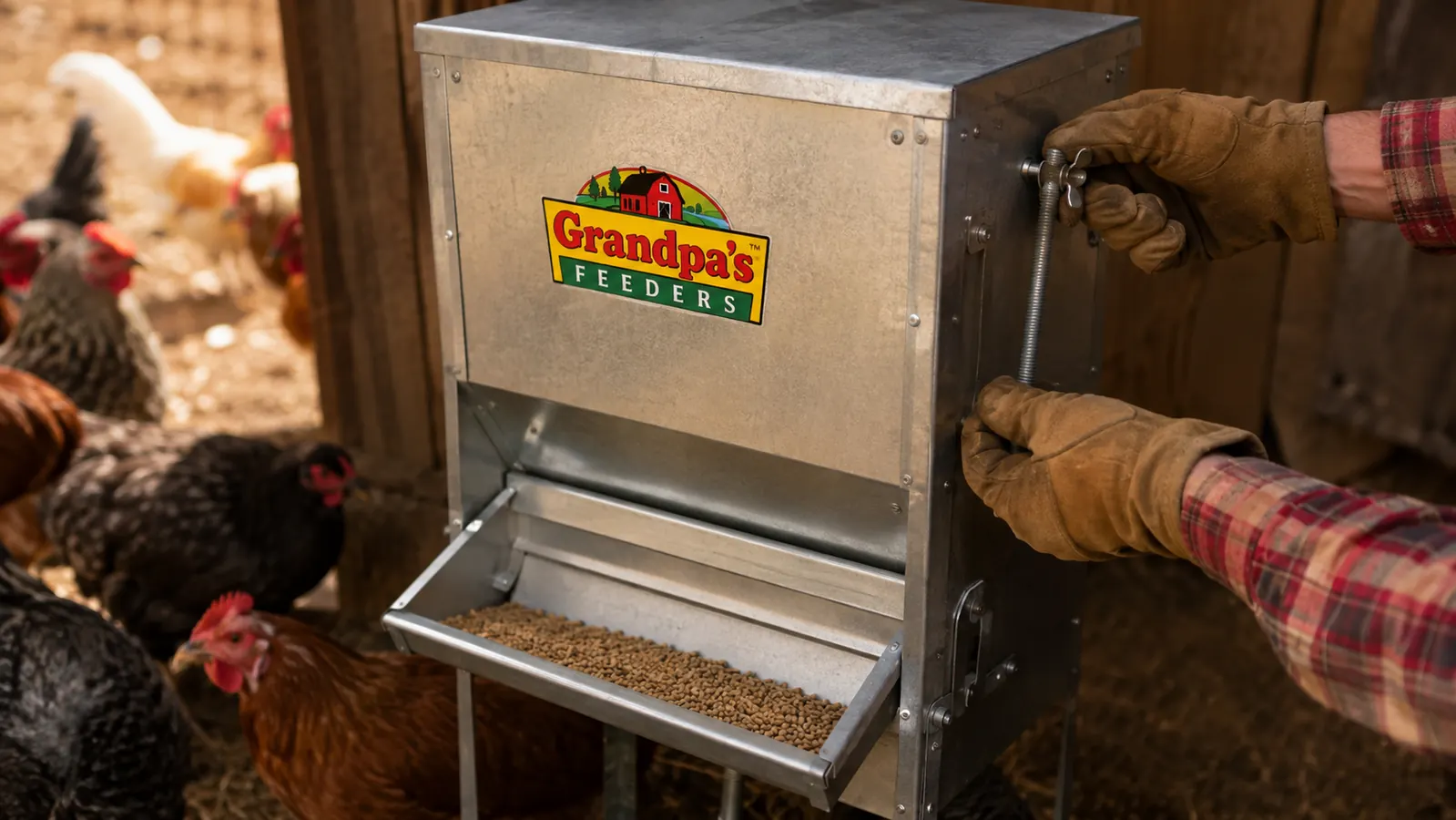
Setup sounds simple on the page: bolt on four legs, hang the counterweight rod, close the lid, done. In reality it took me most of a Saturday, and not because the assembly is hard. The steel is heavy and well made, and the pieces go together cleanly. The time went into tension, which is the whole game with a treadle feeder and the thing the instructions barely dwell on. The counterweight rod has a fine threaded end and a wing nut that controls how hard the lid fights to stay shut, and getting that sweet spot took trial and error all afternoon.
The first honest humbling moment came the next morning. I had screwed the counterweight too tight, sure I wanted the lid clamped down against every rat on the place, and my lightest pullet could not trip it. She stood on the platform, bounced, and the lid stayed shut. My heaviest hen, meanwhile, could open it with a casual step. I backed the tension off a quarter turn, then another, and I kept adjusting until my two biggest birds could open it easily and the smallest one still could with a determined hop. That is the number that matters, and it is different for every flock, which is the thing nobody can set for you at the factory.
Once I had the tension right, the hens learned the mechanism faster than I feared. The first curious bird put a foot on the platform while I was standing right there, the lid opened, and she had her head in the tray before she quite understood what she had done. Within about a week the whole flock had it. But that was the easy part. The part that kept surprising me, and the part I want you to know about before you hand over your money, is what happens after the novelty wears off.
The Lid Is the Heart of It, and the Lid Is the Problem
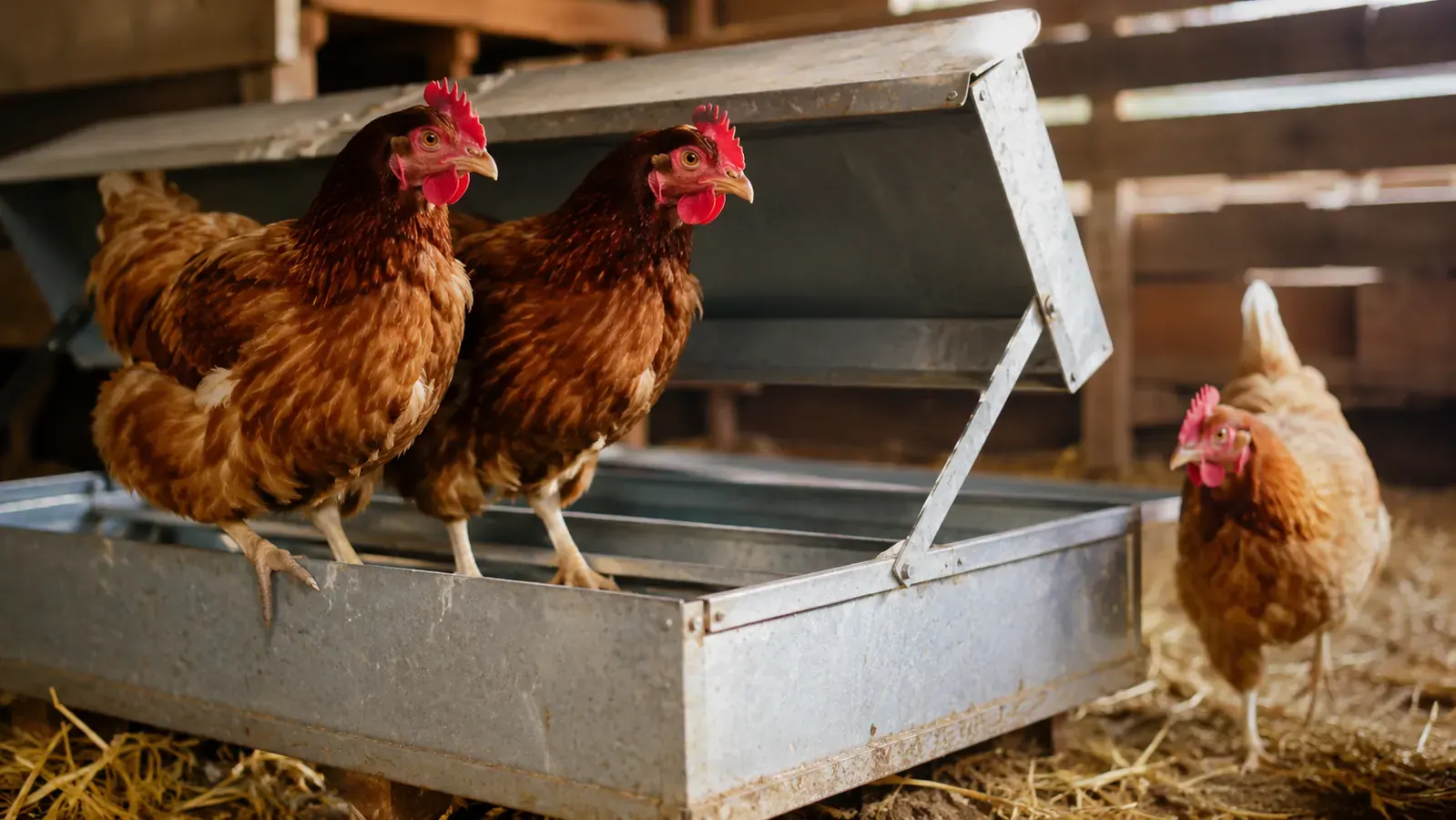
Here is the honest mechanic's truth about Grandpa's Feeders: the whole design lives and dies on whether the lid seats flush against the tray when nothing is on the platform. When it seats flush, you have a sealed steel box and the rats are out of business. When it does not, you have an open feeder with extra steps, and you will not always notice until you find the tell-tale scatter on the floor again. The biggest cause of a lid that will not quite close is birds perching on top of the hopper.
Hens love to roost on the highest point they can reach, and the flat lid of a 20 lb hopper is a very tempting roost for a bored bird. The trouble is that a hen perched up there tips the feeder forward and shifts the mechanism off its balance point, and over a day or two of that the lid starts hanging a finger's width open even when the platform is empty. That gap is exactly what a rat needs. I lost a week of sleep to this before I realized the feed was going out the top, not through the treadle. My fix was to set a scrap of 2x4 next to the feeder as a more comfortable roost, which worked, but it was a solution I had to invent, and I have seen a lot of reviewers hit the same wall and blame the feeder.
The second lid reality is condensation and moisture. The hopper is a sealed galvanized box, which is great for keeping rodents out and not great for letting humidity escape. In a damp spring, I have opened the top to find the crumble at the bottom of the hopper slightly tacky where moisture had collected, and once a clump formed near the tray outlet. It is not a huge deal, and a monthly hose-out and dry in the sun handles it, but it is one of those things the glossy photos do not warn you about. If you live somewhere humid, plan to clean the hopper more often than you think you need to.
Who It Actually Works For, and the Boss-Hen Reality
The other thing the reviews skip is chicken behavior, and it matters more than the steel. A treadle feeder only feeds the bird that is standing on the platform at any given moment. That is fine, even fair, but hens do not queue politely. My boss hen, a belligerent Rhode Island Red named Harriet, learned within a week that she could wedge her whole body onto the platform and hold it there while she hogged the tray, and the more timid birds at the back of the flock would stand and wait rather than shoulder in. For a few weeks I worried my shyest hen was not eating enough.
I solved it the old-fashioned way, which is to say I stopped worrying and checked her weight at the monthly handling. She was plump and fine, because the tray is long enough for two birds to eat side by side and she simply came in when Harriet stepped off. But the lesson stands: if you keep a very pecking-order-heavy flock, or if you have one bird you specifically need to be sure is getting fed, a single treadle feeder may not give you that certainty. It feeds the flock as a whole very well. It does not guarantee that any one bird, especially the low bird, gets her share.
The day I knew I had to stop blaming the feeder was the morning I found the lid hanging open and watched my boss hen Harriet perched on top of it, looking proud of herself. The design was fine. My roost situation was not.
The Rodent Question Nobody Wants to Hear
Let me be straight about the rat-proof claim, because the marketing makes it sound absolute and it is not. Grandpa's Feeders stops the ordinary rat, mouse, and wild bird the vast majority of the time, and that is a real and valuable thing. But a big, determined rat, the kind that has been living fat on spilled feed for months, can occasionally stand on the platform just like a hen and trip the lid. It is heavier and more vulnerable, and it does not come back often, but it can happen, and I would rather you hear it from me than discover it on a disappointing night.
The honest framing is that a treadle feeder is the single most effective thing you can buy to cut off a rodent's easiest food source, and it did thin our rat problem dramatically. But it is not a magic wall, and anyone who tells you a feeder alone ends a rodent problem is selling hope. The rats started to disappear from our coop only once I paired the feeder with the other changes: sealing the feed bin, clearing the brush pile the rats were nesting under, and being honest that I had been feeding stray grain to a raccoon-sized appetite for a year. The feeder is the biggest single swing, not the whole game, and it is not the whole game for anyone.
The Setup and Maintenance You Should Plan For
Plan for the first fill to be awkward. A 20 lb hopper holds a lot of feed, and a nearly full hopper is a heavy thing to lift up to the feeder, especially if you are not tall. I keep mine on a low sturdy crate so the top sits around hip height, which turns filling from a shoulder strain into a smooth tip from a five gallon bucket. That one change made daily life dramatically easier, and it is not in the instructions. If you are short or have a bad back, factor this in before you buy the big model.
Maintenance is light but not zero. I scrape the tray every couple of days to clear the powder and fines that build up in the trough, because crumble dust packs down and slows the flow when the tray is nearly empty. Once a month I take the hopper off, hose it out, and let it dry in the sun. The galvanized steel has survived a full year of rain, mud, and the occasional wash-down without a spot of rust I could find, and the whole thing comes apart with an Allen key. That repairability is a genuine strength and a big part of why the up-front price bothered me less the longer I owned it.
What I Liked
- Truly stops wasted feed once the hens learn it and the lid seats flush
- Galvanized steel is heavy and took a year of rain and mud without rusting
- Comes apart with an Allen key and is genuinely repairable, not throwaway
- Big capacity means a dozen hens can go days between fills
- The single most effective tool for cutting off a rodent's food source
Where It Falls Short
- Not plug-and-play: the counterweight tension needs a full afternoon of tuning for your flock
- Birds will perch on the flat lid and wedge it open if you give them a reason
- Hopper traps moisture in a damp climate and needs regular hose-out and drying
- A big rat can occasionally trip the treadle; it is not a perfect wall
- It is an expensive, oversize answer for anyone keeping fewer than six birds
The reviews all say it saves feed, and it does, but nobody tells you the saving only starts once you have spent a weekend tuning the tension and outsmarting a hen that wants to roost on the lid.
Who This Is For
Buy Grandpa's Feeders if you keep six or more birds, if you have actually seen a rat or mouse or persistent wild bird duck into an open feeder, and if you are the kind of person who reads reviews with a Torx set already in the drawer. It is for the keeper who does not mind half a Saturday getting the tension right, because once it is right it stays right for months, and the reward is a coop floor you stop sweeping every morning and a feed brag you stop losing to the local wildlife. It is the right answer for people who want a mechanical fix that works whether or not they remember to close anything at night.
It is also for the keeper who hates throwing things away. The whole reason I can look past the price and the setup is that this is a tool built to be cleaned and fixed, not a plastic gadget that cracks in its first winter and goes in the bin. If that kind of gear matters to you, which it does to me, Grandpa's Feeders earns its place even with its quirks.
Who Should Skip It
Do not buy Grandpa's Feeders if you keep only two or three hens. The 20 lb capacity and the current price outstrip a tiny flock, and a lighter, cheaper feeder will do the job without the tuning weekend. Do not buy it if you are not prepared for the learning curve, because the tension and the perching problem are real, and a keeper who expects it to work out of the box will be disappointed in week one. And if you genuinely do not have a rodent or waste problem, this is the most expensive possible solution to a problem you do not have. It is also not a substitute for the rest of rat control; it is the strongest single tool, not a wall. Buy it because you are done hand-feeding the wildlife and you are willing to spend a weekend making it work, and it will earn every dollar.
The honest bottom line: it takes a weekend to love it, and then it is the feeder you stop thinking about.
Grandpa's Feeders treadle feeder stops wasted feed and thins the rats like nothing else we tried, as long as you tune the tension and break the perching habit. If your flock is big enough to make a treadle worth it, this is the one to start with.
Amazon Check Today's Price on Amazon →