
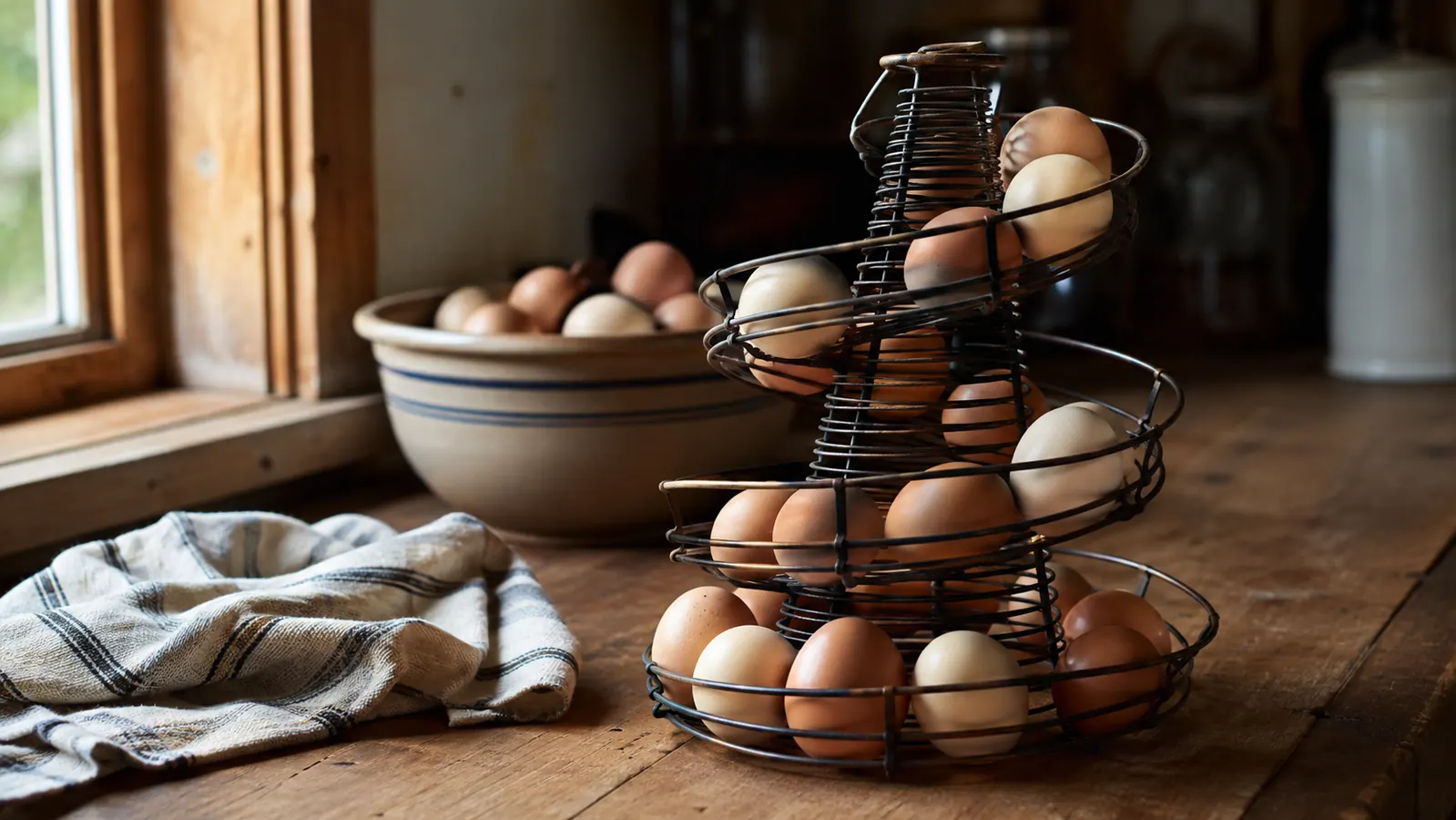
If your kitchen looks anything like mine in late spring, you've got eggs absolutely everywhere. The cardboard cartons stack up in the fridge door, the older eggs disappear behind a fresh dozen you pulled from the nesting boxes yesterday, and by the time you finally find the ones from two weeks ago, they've already gone to the compost bucket. I kept a cereal bowl on the counter for years, then a cheap plastic rack, then I just stopped keeping track and let the cartons do whatever they wanted. None of it worked. Fresh eggs need oldest-first rotation and a clear view of what you actually have, and a cardboard carton or an open bowl gives you neither.
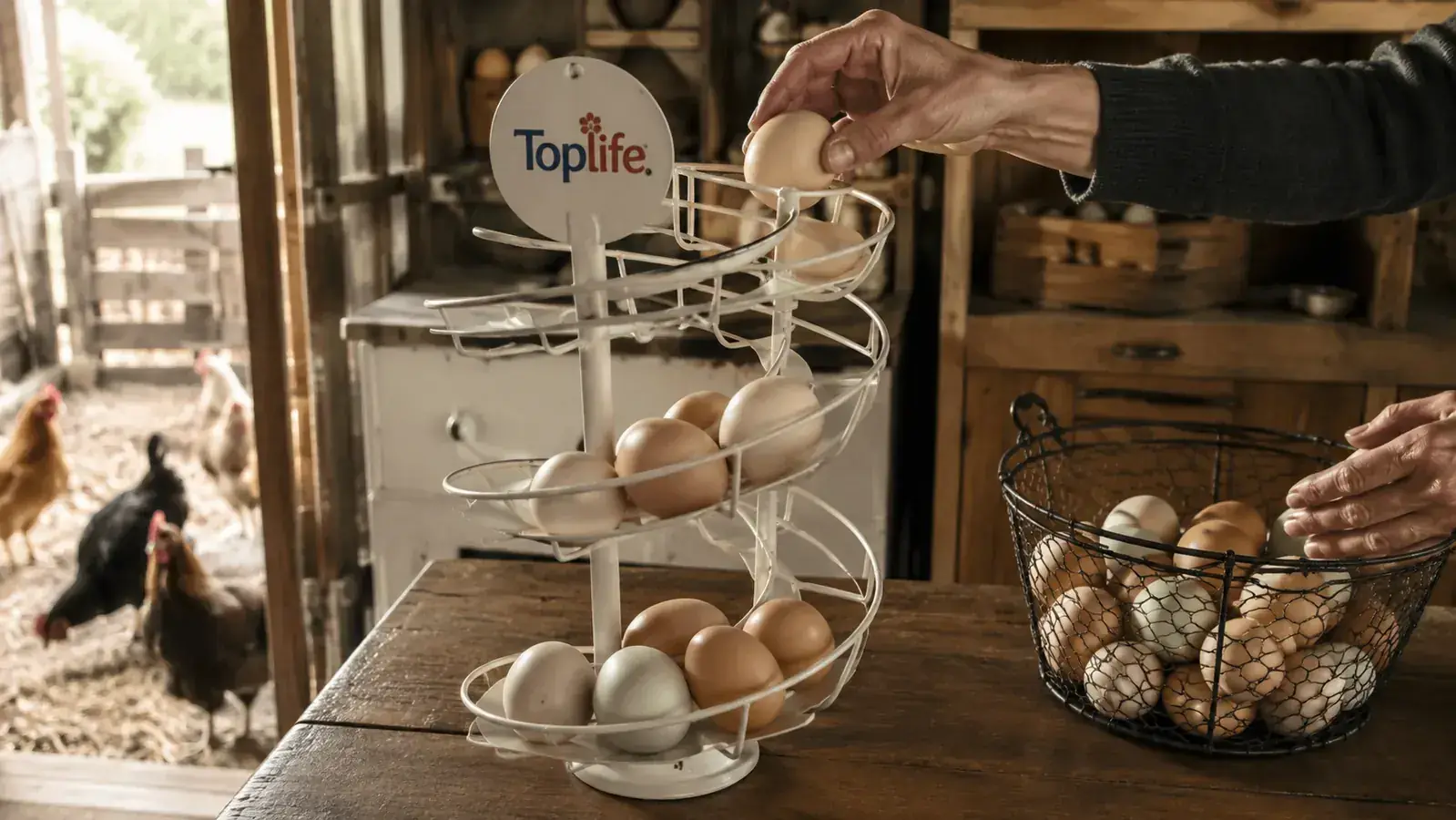
That is the problem the Toplife egg skelter finally solved for me. It's a spiral metal rack that holds the eggs on their sides and lets the next one roll down as you lift out the front egg, so the oldest egg sits at the front every single time. I've had one on my counter for a full year now, through two heavy laying seasons and one very quiet molt, and this is the honest long-term review of what it did, what it didn't, and whether you need one as much as I thought I did.
The Quick Verdict
The simplest tool in my egg routine. It only holds about 18 eggs and won't fix a sloppy rotation habit, but for oldest-first and a countertop you can actually see, it does exactly what it promises.
Amazon Check Today's Price →A Year Later, It Still Rolls the Oldest Egg Out First
After twelve months of daily use, this is the one piece of egg gear that has never once let me down. If you're tired of digging through cartons to find fresh eggs, this is where I'd start.
Amazon Check Today's Price on Amazon →How I've Used It
I keep about a dozen hens on our place, a mix of Reds, an Easter Egger, and a couple of old Barred Rocks who still manage to lay every other day. In peak season that's eight to ten eggs a day, which means I'm gathering twice a day and the counter fills up fast. The skelter sits at the back of the counter, out of the way of the coffee pot and the dog's nose, and it's where every clean, unwashed egg ends up.
Here's the rule I follow, and it's the same one I'll give you: eggs I'm keeping for the kitchen table stay on the counter in the skelter, unwashed, because the bloom keeps them good on the counter for a couple of weeks. Eggs that get washed, or that sit too long in hot weather, go in the fridge. So the skelter holds the daily harvest that's about to become breakfast, and the cartons in the fridge hold the overflow.
Loading it is the part people get wrong. You don't dump eggs in from the top. You nestle each one into the track so it sits on its side, and you let the row behind it nudge it down the spiral. Once the track is full it holds about 18 eggs, and lifting the front egg out lets the next one roll down into its place. It becomes a habit fast, the kind you stop noticing, which is exactly the point.
The footprint matters more than the photos let on. It's tall and narrow rather than wide, so it tucks into the corner behind the toaster without eating the whole counter. That surprises people, because a rack that holds 18 eggs looks like it should take up half the kitchen. In practice it's maybe a foot and a half of counter top, and the eggs stack vertically up the spiral, so you get a lot of storage in a small patch of real estate. My kitchen isn't big, and it never felt crowded with the skelter in it.
The Spiral That Keeps the Oldest Egg First
The whole value of a skelter is that gravity does your thinking for you. Eggs go in at the top of the spiral and roll toward the front one track at a time, so the egg that's been sitting the longest always ends up at the front, ready to grab. With a carton, you have to remember which end you pulled from last and which dozen is older. With the skelter, you just take the front egg and one more rolls down behind it. First in, first out, with zero thought involved.
For a small flock that's a quiet but real money-saver. In a month where I gather three hundred eggs, running them oldest-first means a whole lot fewer cracked-out, gone-off eggs heading to the compost and a whole lot more making it to the frying pan. If you've ever found a carton of forgotten eggs hiding behind a milk jug, you already know the exact problem this fixes.
The other thing I like is that it keeps eggs out in the open where I can see the harvest. There's something about a counter rack full of brown and cream and the occasional blue egg that makes the work of keeping hens feel worthwhile. It's a small thing, but on a cold, mud-soaked February morning it counts for more than you'd expect. Every time I crack a fresh one at the stove, I know exactly how old it is, because it's the one that's been sitting on the front of that spiral.
The skelter holds about 18 eggs, and I can tell you which one is oldest without opening a single carton. That alone is worth it to me.
What the Metal Holds Up To
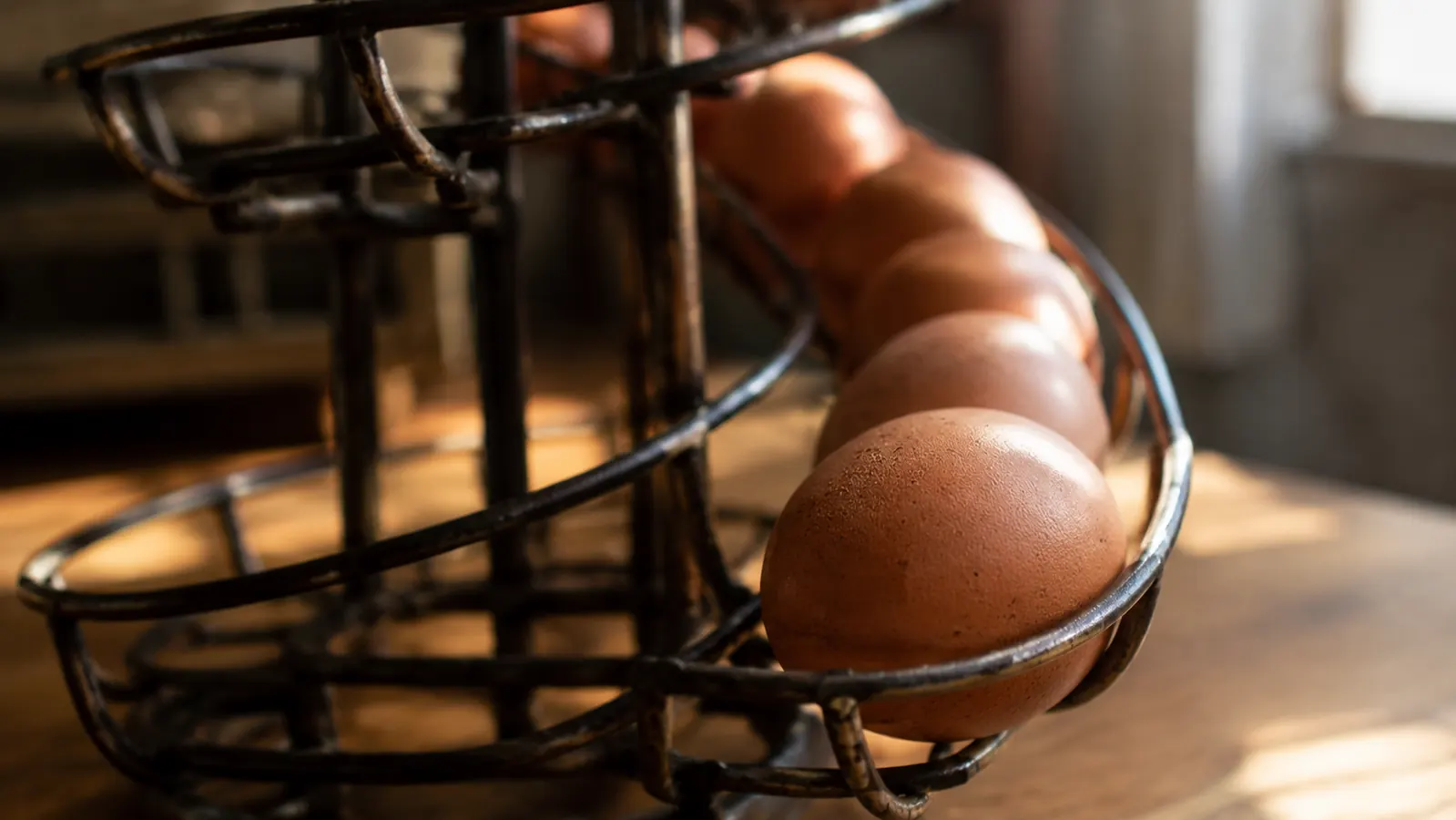
It's a coated metal rack, and mine has spent a year sitting on a kitchen counter that sees flour dust, coffee drips, and the occasional splash from the sink. I wipe it off with a damp cloth every week or so and it still looks as good as the day it arrived. The rose gold finish hasn't chipped or tarnished, even around the edges where eggs roll across the track most often. For a piece that cost as little as the Toplife does, that level of staying power is better than I expected.
One honest knock: the base lifts up with the rack, so you can't lift the spiral off to clean the bottom track the way you might want. On the counter that hasn't been a real problem, because eggs on the track don't tend to leak and anything that drips gets wiped up before it dries. But if you were hoping to deep-clean the whole thing in the sink on a regular basis, it's more of a wipe-down-and-move-on piece than a take-it-apart piece.
And once in a great while, if you fill it a little too full or bump the counter hard, an egg can rock sideways and not seat into the track quite right. You notice it, set it right, and move on. It's not fragile, just a piece of metal doing a simple job, and simple jobs are easier to live with than clever ones. That plain, no-nonsense quality is the whole reason I trusted the Toplife as far as I have.
Counter Eggs Versus the Fridge, Settled
If you're new to keeping hens, the whole counter-versus-fridge question can trip you up, so here's the short version. Fresh eggs straight from the hen have a protective coating called the bloom, and as long as you leave that bloom on by not washing them, they keep fine on the counter for a couple of weeks. Your grocery-store eggs are already washed and refrigerated, so they have to stay cold. The skelter is built for the unwashed, homegrown kind, and that's the kind you should keep on the counter anyway.
If you wash your eggs the moment you gather them, the counter is doing you no favors and you're better off in the fridge. Same for eggs that sit out in a hot summer coop with no air movement. But for the daily harvest you're feeding your family within a week or two, the bloom keeps it safe, and the skelter is the cleanest way to keep that harvest visible and oldest-first.
One more thing worth knowing: eggs don't care much which end is up, but they do better on their side than standing on end for long stretches, because the yolk settles in the middle of the shell. The skelter holds them on their sides along the spiral, which is the gentler way to store them, and that's another small point in its favor against a carton that stands them up.
The One Thing to Know Before You Buy
Capacity is the honest limitation. Eighteen eggs sounds like a lot until you've got a dozen hens in peak season and a full egg basket lunch shift. My skelter spends a good part of spring either completely full or refilled twice a day, and the overflow has to live somewhere else. If your flock is bigger than mine, or if you like to hold eggs back for a friend or a market, you'll want two of these or a bigger egg storage setup, not one.
It also won't fix a careless routine. If you're the kind of person who reaches into the middle of a pile and grabs whatever egg looks biggest, no rack in the world will keep your eggs oldest-first for you. The skelter rewards the one simple habit of taking the front egg and refilling from the back. Follow that and it runs itself. Ignore it and it's just a pretty rack, which is a shame, because the Toplife is genuinely more useful than a pretty rack deserves to be.
What I Liked
- Oldest egg always rolls to the front, first-in-first-out without thinking
- Holds about 18 eggs on a narrow countertop footprint that fits most kitchens
- Coated metal finish has held up to a year of daily use without chipping
- Keeps the daily harvest visible, which makes breakfast planning easier
- Simple enough for a first-time chicken keeper to use from day one
Where It Falls Short
- Capacity stops at about 18 eggs, so a big flock needs overflow storage
- The whole rack lifts with the base, so deep cleaning is a wipe-down, not a soak
- It depends on you actually refilling from the back, or the rotation still falls apart
Who This Is For
The skelter is for the backyard chicken keeper with a small to medium flock who gathers a dozen or so eggs a day and actually wants to use them, not lose them. It's for the person who is tired of finding a forgotten carton in the back of the fridge and who wants the daily harvest out where it's easy to grab for breakfast. If you keep a handful of hens, or you're just starting out and your egg count is still small, this is just about the cheapest and most useful thing you'll add to your kitchen routine.
I'd also point a brand-new chicken keeper at it on purpose. A lot of the learning curve with hens is figuring out rhythm and rotation, and the skelter teaches that rhythm for you by making the oldest egg the obvious choice every morning. It turns a chore you'd otherwise have to remember into something the rack just does. For someone still finding their feet with a first flock, that's worth more than any gadget with a screen and a timer.
Who Should Skip It
Skip it if you wash every egg the moment it's gathered, because washed eggs belong in the fridge and a counter rack won't help you. Skip it if you keep a big flock and gather thirty or forty eggs a day, because eighteen won't make a dent and you need proper bulk storage. And honestly, skip it if you know, deep down, that you'll never maintain the refill-from-the-back habit. The skelter is a tool that rewards a routine, and if you won't keep the routine, save your money.
Don't buy it expecting it to hold your whole spring harvest or to look like kitchen art. It's a working tool, not a display piece, and it does one job well. If you live alone and eat two eggs a week, you probably don't need a rack that holds 18. But if you feed a family and gather from a small flock, this is the kind of simple, dependable thing that earns its spot on the counter every single morning.
The Counter Egg Rack I'd Buy Again Tomorrow
A year in, I have no real complaints and a much better egg rotation. If you're ready to stop losing eggs to the back of the fridge, this is the rack that keeps the oldest one right at the front, ready for breakfast.
Amazon See Today's Price on Amazon →