
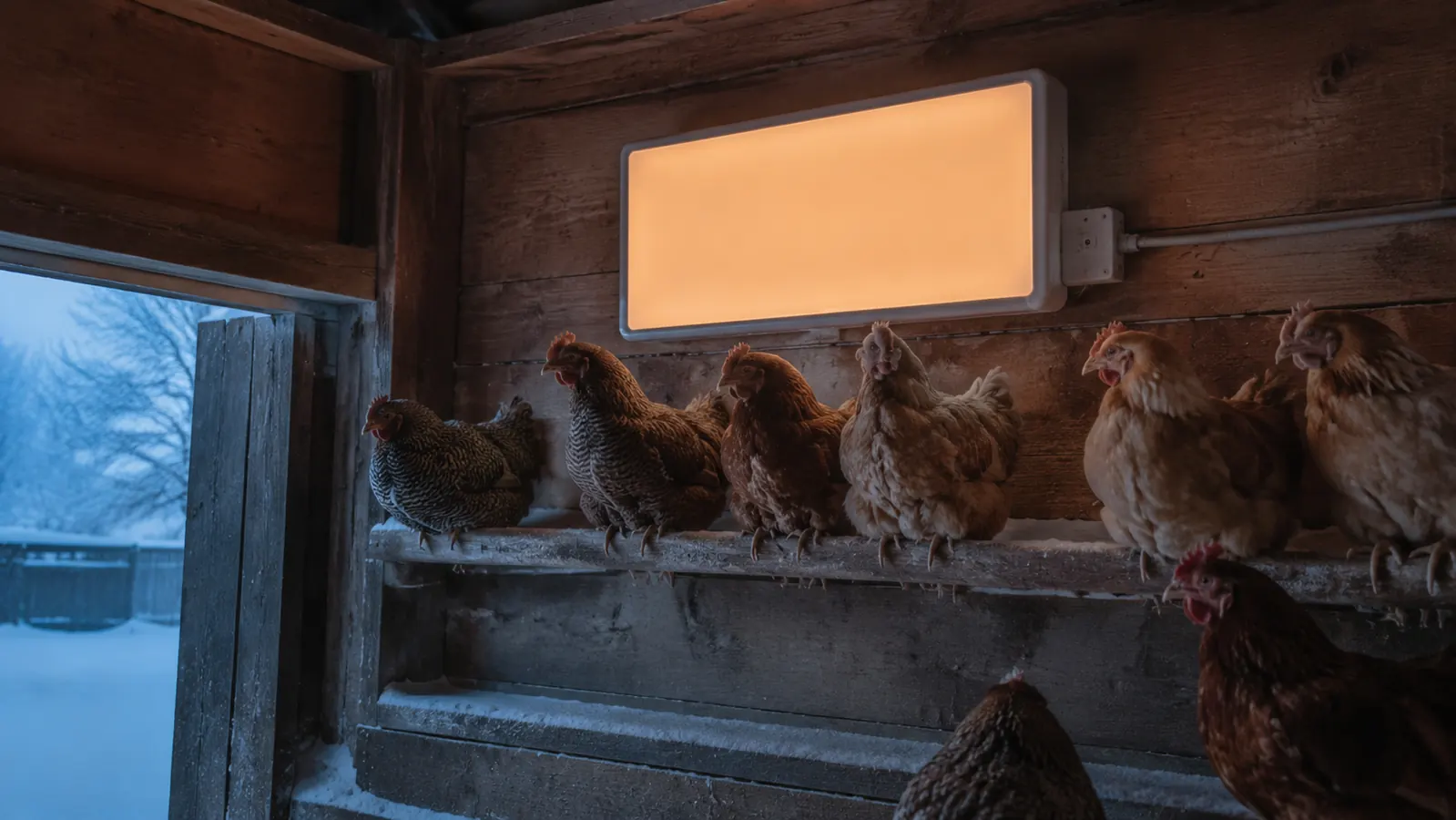
I hung a heat lamp over that roosting bar for five winters, and I never gave it a second thought until the January my cattle dog bumped the feeder and the whole fixture thumped against the dry pine shavings. Nothing caught that night. But I stood there in the dark with my heart in my throat, thinking about every dusty corner, every piece of straw the draft could toss, and every time that bulb had swung in the wind, and I finally admitted I had been running a coal mine about two feet above my best laying hen. That spring I pulled the lamp down, boxed it up, and put up a Cozy Coop flat-panel heater instead. This is the honest side by side, a whole cold season later, in case you are weighing the same trade.
The short answer is that the Cozy Coop heater and a heat lamp do not warm a coop the same way, the fire risk is not even close, and for a normal backyard flock of six to a dozen birds the flat panel is the safer, more sensible choice. The lamp throws heat and light upward and outward into the whole space. The Cozy Coop is a two-inch-deep radiant panel that you mount flush to the wall, and it warms whatever is directly in front of it, which is to say the bird standing on the roost. That single difference drives everything else: the safety, the power bill, and how much the birds actually get out of it. Let me walk you through it the way I wish someone had for me back when I was hanging that first bulb.
| Cozy Coop Heater | Heat Lamp | |
|---|---|---|
| Fire risk | Panel surface stays warm, not glowing hot; no open bulb | Exposed bulb runs hot and can ignite straw, dust, or a swinging fixture |
| Heat style | Radiant panel warms the bird directly in front of it | Radiates heat and light up into the whole coop airspace |
| Mounting | Flush to wall or free-standing, 2 inches deep, stays put | Hangs on a hook or chain and can swing or fall |
| Energy use | 150 watts, runs cool, cheap to leave on all winter | 250 watts and up to an incandescent bulb, more draw |
| Light at night | No bright light, birds sleep normally | Glows red or white, can disrupt rest if too close |
| Best fit | Small insulated coop, a few birds on a winter roost | Shed or drafty space that needs whole-area warmth |
Before I go on, let me be clear about the one thing that matters most, because I do not want to scare anybody into a different set of bad habits. Heat lamps are not automatically a death sentence for chickens, and I am not going to tell you that a lamp will burn your coop down tonight. Plenty of people run them for years without a problem, and I was one of them. What I can tell you is that the lamp is the single most common cause of coop fires I have read about in the homestead groups I have been in for years, and it is the only piece of winter gear that can fail in a way that takes the building with it. The failure is almost never the bulb itself. It is the bulb swinging on a gust, a hen that flutters up onto the cord, or a long piece of straw that rides a draft up and lands across the hot glass. The Cozy Coop panel removes that whole failure mode almost entirely, because there is no glowing element left to catch anything. For me, that peace of mind was the entire argument.
The safer way to keep your flock on the roost all winter
If you are still running a heat lamp over dry shavings, the flat-panel Cozy Coop heater is the upgrade that removes the risk you have been living with. It mounts flush, runs on just 150 watts, and was built for exactly this job.
Amazon Check Today's Price on Amazon →The Difference Between Radiant and Glowing Heat
It helped me to understand the actual difference in how these two put out heat, because that is where the whole safety picture comes from. A heat lamp is a point source. It makes a small element so hot that it glows, and that glowing surface radiates energy in every direction, heating the air around it, which then drifts up to the ceiling of the coop. Wherever that radiant energy lands, it can transfer enough heat to a flammable surface to start a smolder. If a bird gets too close to the reflector, or a piece of bedding sits against the bulb for a night, that smolder has real fuel to work with.
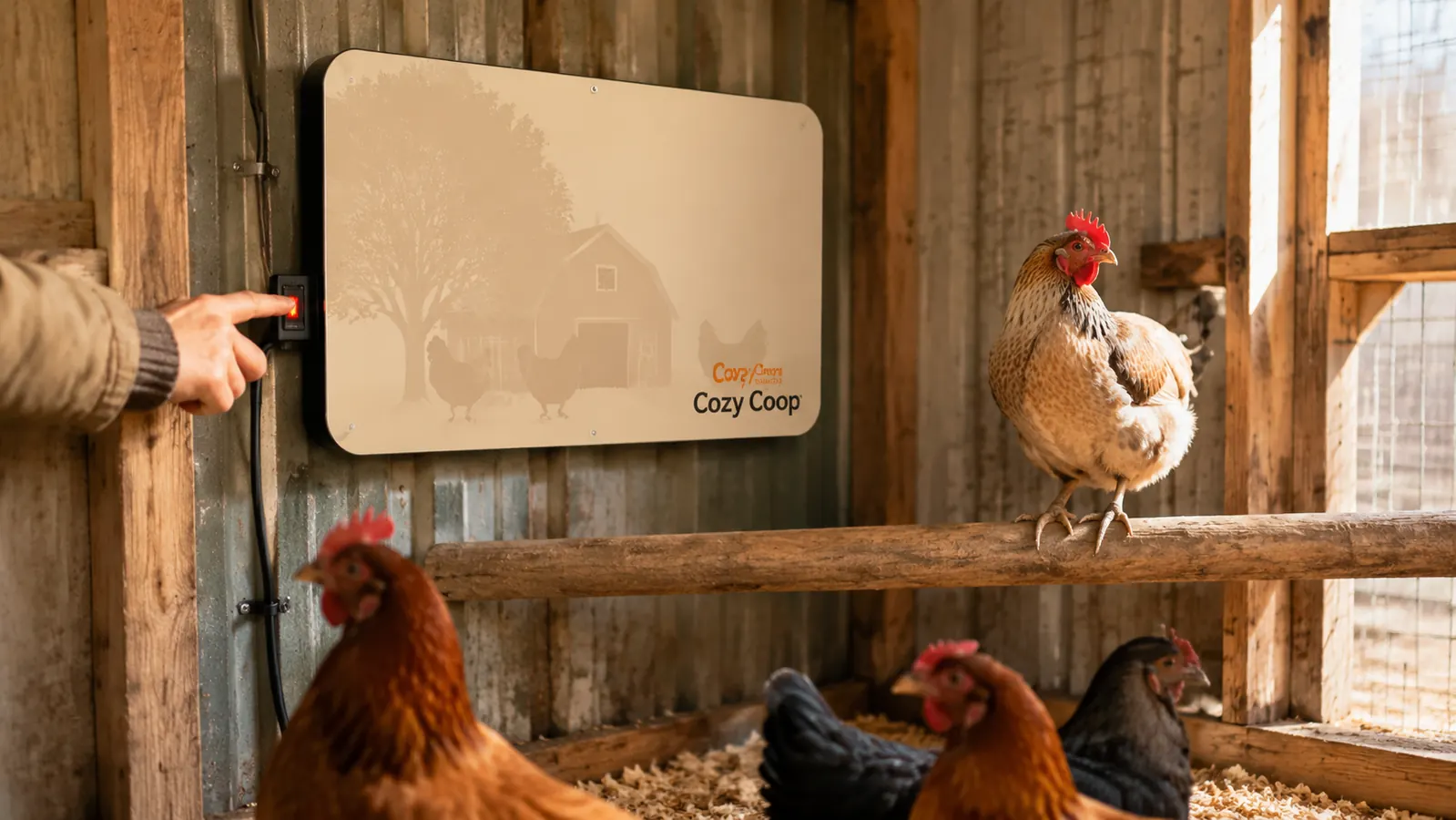
The Cozy Coop panel is a different animal. It is a large, flat, sealed surface that runs warm to the touch but never gets hot enough to glow. Instead of throwing energy out into the whole airspace, it radiates gentle heat straight at whatever is in front of it, the way a wood stove throws warmth at the people sitting near it. Because the surface never reaches a temperature that can singe pine shavings, it cannot set the bedding on fire no matter how a hen bumps it or how the straw drifts. That is not marketing talk. It is a genuinely different way of delivering heat, and it is the reason I stopped holding my breath every time I opened the pop door on a cold night.
Where the Cozy Coop Wins
Start with the fire safety, because it is the reason I made the switch and it is the reason I would tell any first-time keeper to skip the lamp and start here. A heat lamp puts 250 watts through a bulb inside a metal reflector that hangs on a chain, and the whole thing is designed to be hot to the touch. One gust of wind swings it into a wall, one curious hen perches on the cord, one piece of straw lifts up on a draft and touches the bulb, and you have a problem that a glass of water is not going to fix. The Cozy Coop panel is a sealed, flat ceramic-front unit that sits flush against the wall. It gets warm, not glowing. You can rest your palm on it. There is no open element and no bulb to shatter, and that is a genuinely different risk profile, not a marketing one.
The second place it wins is the running cost and the daily convenience, and this is where the watts actually show up on your bill in January. At 150 watts the panel draws noticeably less than a 250-watt lamp, and because the thermostat inside it waits for the coop to fall to about 32 degrees before it kicks on, it is not burning power on mild nights the way a lamp that is simply switched on all winter does. I noticed the difference on my electric bill within a month, and it was small, but it was real. And because there is no bulb to burn out, I have not climbed onto the roosting bench to replace one all season. I mounted mine once in October, plugged it in, and it has been on every night since. That is the kind of winter gear I value most out here.
I mounted the Cozy Coop panel once in October, plugged it in, and it has run every night since without me touching it once. No bulb to replace, no swinging fixture to worry about, and a January power bill that actually got a little easier. That is the kind of winter gear I trust.
Where the Heat Lamp Wins
I want to be fair to the old lamp, because people who have kept chickens for a long time will not be hard to convince out of it without an honest accounting, and fairness is part of being useful. The heat lamp warms more of the coop, full stop. Because it throws heat and light up into the airspace, it takes the raw edge off a drafty shed in a way a flat panel aimed at one roost never will. If your coop is large and not well insulated, or you are trying to keep the water in a big drafty run from icing over, the lamp blankets the whole space more thoroughly. That is the one job where the lamp genuinely does more, and if that is your setup, I would not pretend otherwise.
The lamp also costs less to buy up front, and it is everywhere, so replacing a busted fixture is easy. If you already own one and your setup is already in place, and you are extremely disciplined about securing it with a real chain clamp and keeping loose shavings swept well back from the bulb, you might reasonably keep running it another season. I set mine up the same careful way for years. I just finally reached the point where 'extremely disciplined' was doing a lot of work in a sentence about a hot bulb hanging over a pile of straw, and I could feel that I was only one careless morning away from a bad day. The Cozy Coop panel asks a lot less of me, and for a hobby I do before my morning coffee, that matters more than I expected it to.
What a Heater Actually Does for Chickens in Winter
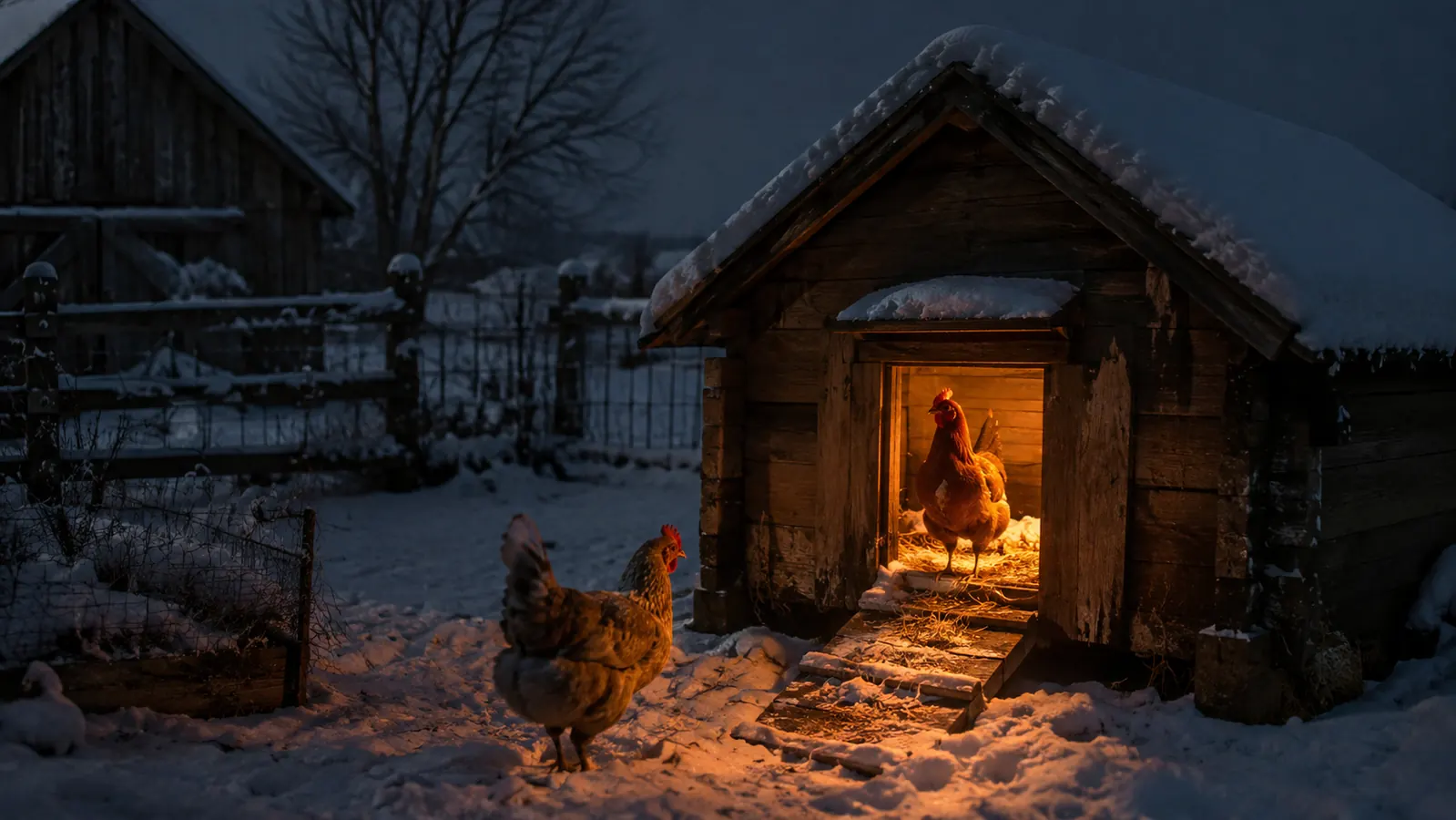
Here is the thing nobody tells you before you buy either one, so let me say it plainly: a healthy, fully feathered adult hen will survive a cold, unheated coop. Chickens puff up, tuck their heads under a wing, and ride out single digits just fine as long as the coop is dry, draft-free at the roost, and ventilated up high so moisture and ammonia can escape. Frostbite on combs and wattles is your real winter enemy, and that comes from damp and drafts, not from the thermometer alone. A heater is not a license to skip good ventilation, and it is absolutely not a substitute for dry bedding. I say that because the worst star of winter for a lot of keepers is the mold and moisture a heater can help trap if you go about it wrong.
So what is a heater actually for? Three things, in my book. It keeps the waterer from freezing into a solid block that I have to chip out at 5 a.m. with a cold pair of gloves. It keeps the coop a few degrees above freezing so the hens do not burn extra calories just to stay warm, which helps them keep laying through the short days. And it gives old or lightly feathered birds a warm spot to stand when the cold is truly bitter. The Cozy Coop panel handles all three for my dozen hens in our eight-by-ten coop, and it does it without hanging a fire hazard over their heads. My oldest hen, a four-year-old barred rock with a thin comb, stands closest to it on the frigid nights, and that is exactly the use I bought it for.
Who Should Buy Which
Buy the Cozy Coop flat-panel heater if you keep a standard backyard flock of about six to a dozen birds in a typical wooden coop, you want to stop worrying every time you check on them at night, and you are happy to let the panel do the zoning instead of heating the whole shed. That description fits almost everyone reading this, and it is the recommendation I make without hesitation. Mount it flush to the wall beside the roosting bar, facing the birds, keep the coop dry and ventilated, and it will quietly carry you through the coldest months. If you have ever stood at the coop door at 2 a.m. trying to make sure the bulb still looks right, this is the one that retires that habit for good.
Buy a heat lamp instead if you have a large, poorly insulated space that really does need whole-area warmth, or you are brooding chicks and need heat spread over a wide pen rather than aimed at one roost. For chicks, a proper brooder plate or heat source built for that job beats both a lamp and a panel, so do not reach for either of these for an open brooder. For the everyday winter need of a settled flock of layers, the lamp's wider throw does not earn its fire risk. That is the honest trade, and it is why the Cozy Coop panel lives in my coop now instead of the old bulb.
The Bottom Line
I have now spent a full winter with the Cozy Coop heater, and I can tell you exactly what it did: it kept the roost warm, kept the water from freezing solid, ran on less power than my old lamp, and never once made me hold my breath when I opened the pop door. It did not heat the whole barn, but my hens do not need the whole barn. They need a dry, draft-free place to sleep and a warm spot to stand, and the Cozy Products panel gives them that without an open bulb over flammable shavings. For me, that quiet stack of winter mornings with a fire hazard gone from the building is exactly what I traded the lamp away for.
If you are on the fence because the lamp already kind of works, I get it, I was there for years. But a heater's job is to keep birds safe and comfortable through the winter, and the risk that comes with the lamp wears on you in a way the flat panel never will. I sleep through cold nights now without thinking about the coop, and after a decade of chicken keeping, that quiet is worth more to me than the few dollars a lamp saves up front. If you decide to make the switch, mount it once, plug it in, and let it do the thinking for you.
Give your flock a warm roost without the fire risk
The flat-panel Cozy Coop heater is the winter upgrade that runs all season on just 150 watts and never hangs a glowing bulb over your shavings. If you have been meaning to ditch the heat lamp for good, this is the one to do it with.
Amazon Check Today's Price on Amazon →