
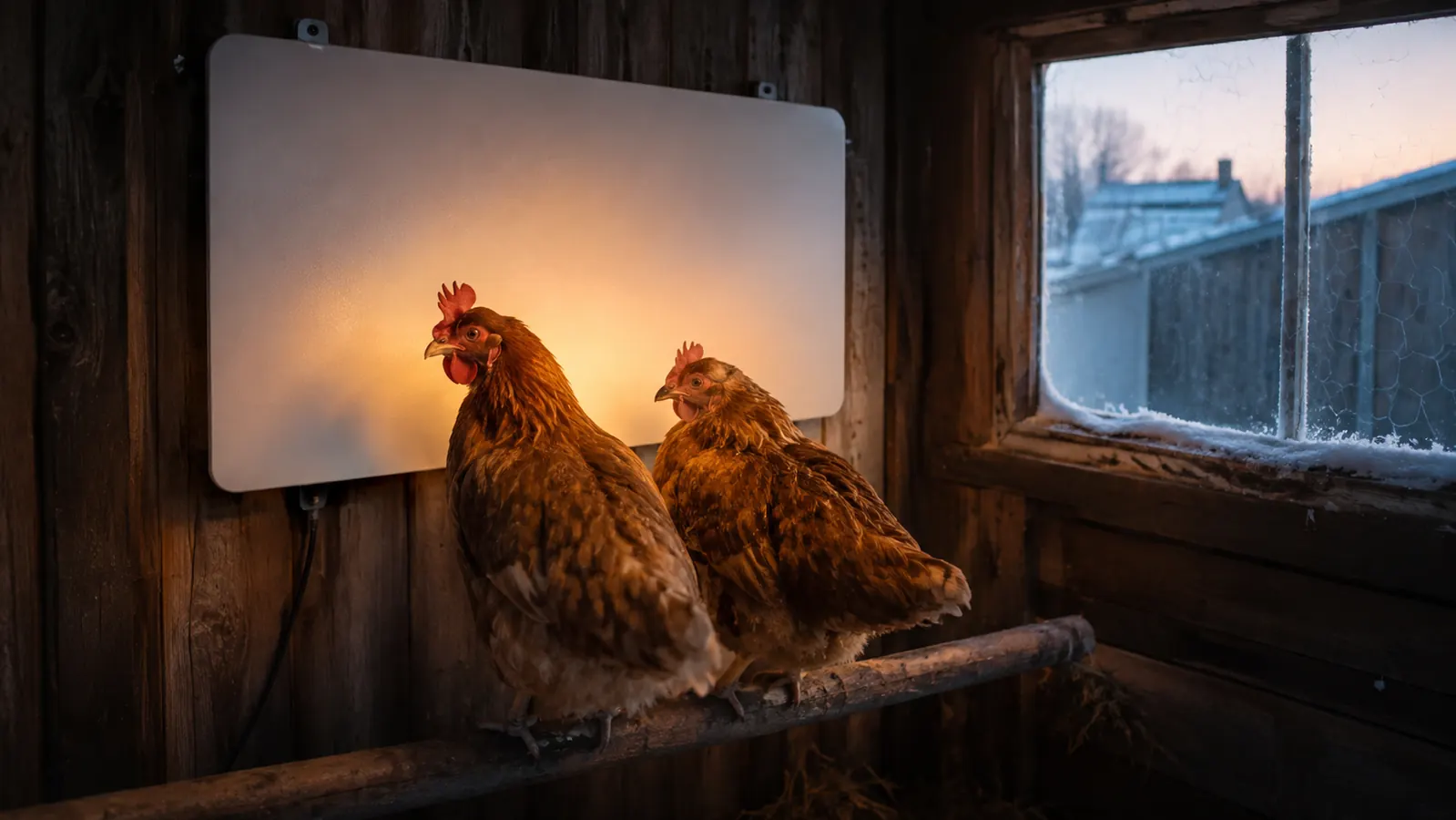
If you have a flock going into its first cold spell, you have probably already heard the same thing I heard: hang a heat lamp over the roost and the birds will ride the winter out fine. That is what I was told, and for two winters I did it, until one night I walked into the coop and that bare bulb was swinging a foot above dry shavings, with my dogs romping around inside after a wet romp in the mud. I knew then that the heat lamp had to go, and the flat-panel Cozy Products heater is what I hung in its place.
Here is what I want to be honest about up front, because it is the thing the five-star reviews bury in the fine print: this heater does not heat your coop. It warms a spot, a body, a roost. It is not a barn heater, it will not thaw your water, and if you expect to walk into a toasty coop on a twenty-degree night, you are buying it for the wrong reason. It took me a season to fully understand what that actually means for my chickens, and it changed how I set up my whole winter. Let me walk you through what the Cozy Coop really does, and what it genuinely won't.
The Quick Verdict
A safe, low-wattage radiant panel that warms a roosting spot well and never threatens dry shavings, as long as you understand it is not heating the whole barn.
Amazon Check Today's Price →A warm roost without the fire risk over dry shavings
If what you want is a safe spot for your hens to huddle through the hard nights, this flat panel delivers it at a wattage that will not scare you. See the current price and compare it to your heat-lamp setup.
Amazon Check Today's Price on Amazon →How I've Used It
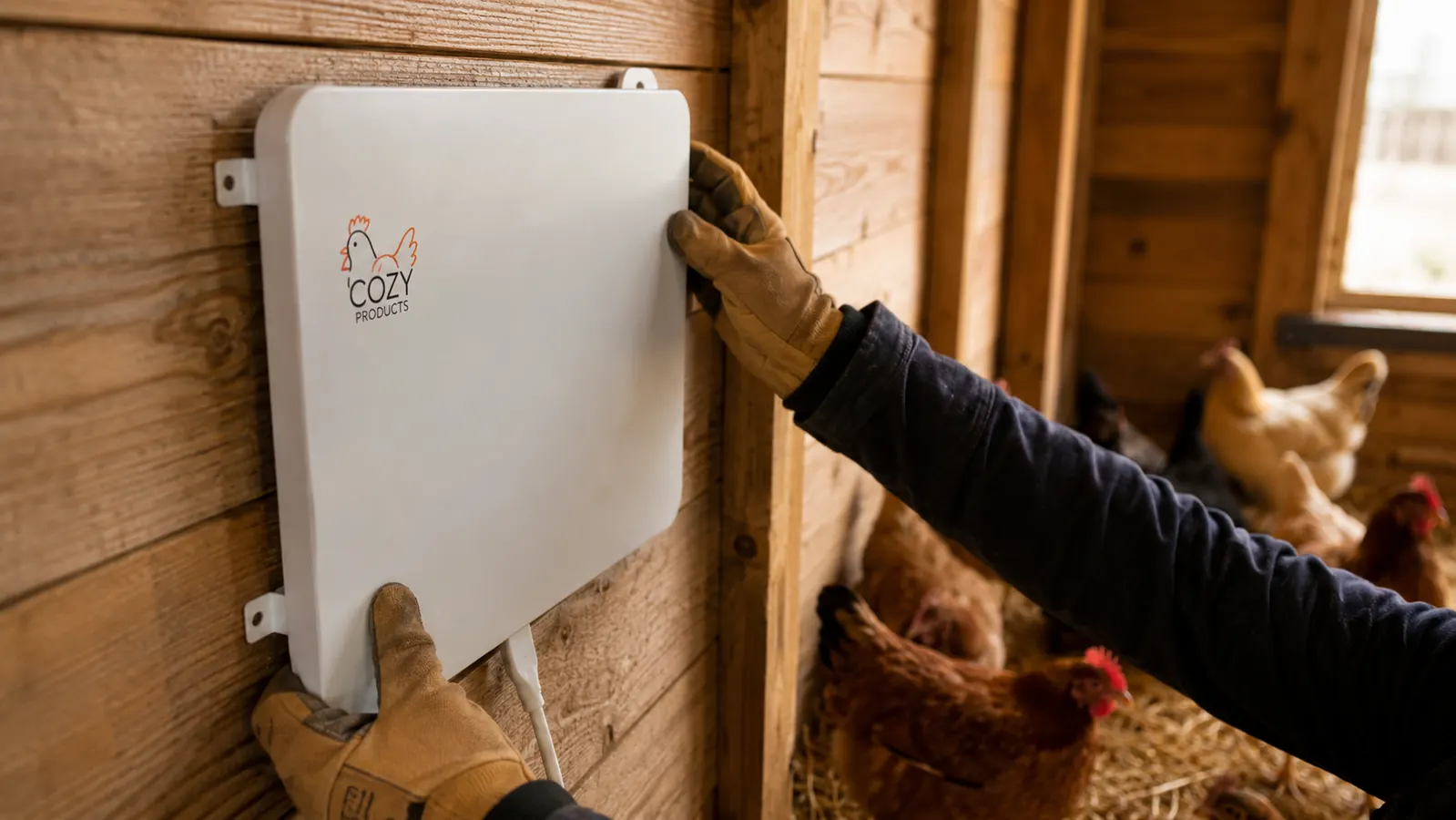
A dozen hens, split between two coops here in rural Missouri. The one that has the Cozy Products panel mounts it to the interior wall just above the roost, tilted down at the perching birds the way the instructions suggest. It has now run through a full winter, nights down into the single digits, and it is still working at the start of this one. The panel draws 150 watts, which is a fraction of what a heat lamp pulls, and that matters when you are running it night after night through the cold months.
My hens figured it out faster than I expected. By the second week they were choosing the perching spots directly under the panel, fluffing up and tucking their heads the way they do when they are genuinely comfortable. On the bitter nights I could watch them gradually pack in tighter along that one stretch of roost rather than spread across the whole bar. That tell me more than any thermostat: the panel was doing real work, and the birds knew it.
It mounts flat against the wall, so there is nothing swinging, nothing a chicken can bump, and nothing that a rat or a curious dog can reach. The surface stays warm to the touch but not dangerous, which is the entire point next to a heat lamp. I have had it on for months at a time and never once had the moment of dread I used to feel walking into the coop with that bare bulb glowing over the shavings. The two brackets on the back line up with simple screw holes, and they give you a couple of mounting height options so you can put the panel right where your roost actually is. Mine took under ten minutes to put up and I have not touched it since. That is the kind of boring simplicity I appreciate, because winter gear that wants fiddling is winter gear I stop using by February.
What It Actually Does: A Warm Spot, Not a Warm Barn
The honest mechanic behind this is what trips everyone up. A heat lamp blasts heat in all directions and can absolutely lift the temperature of a small closed coop. A flat-panel heater like this one is radiant; it warms whatever is directly in front of it, mostly the bodies of the birds on the roost and a little pocket of air around them. It is not trying to warm the volume of the whole space, and it will not get a big drafty coop to room temperature no matter how long you leave it on.
For chickens that is actually the right trade, and here is why. A hen out on a cold roost is not losing heat from the air around her half as much as she is radiating it off her body into the cold spot she is standing on. What helps her is a warm surface and a warm pocket right at the roost, which is exactly what this panel gives her. It keeps her feet and chest out of the deep cold, lets her conserve energy she would otherwise burn trying to stay warm, and that means feed goes to egg production instead of combustion. That is the quiet benefit you do not see in a photo. It is also gentle on the birds in a way a blast of hot bulb heat is not. There is no sudden scorching zone and no cold void between the bulb and the wall. The radiant warmth is steady and even across the spot, so the hens can pick exactly how close they want to be and lean in or back off as they feel like it. A hen that is too hot or too cold will move; this panel gives her the room to find her own comfortable distance, which is the sign of heat done properly.
The wattage tells the real story. At 150 watts this panel uses a small fraction of what a heat lamp draws, and because it is only warming a spot rather than a whole room, it can stay on all night without it feeling wasteful. If you are the sort of keeper who worries every winter about the electric bill and about the bulb, the flat panel answers both worries at once. It is engineered for the job it actually does, rather than overbuilt for a job I never really needed.
Why Ventilation Is the Whole Game (Not the Heat)
Here is the part of winter chicken keeping nobody mentions in the heater listings, and it is more important than the heater itself: the moisture. A coop that is too tightly sealed to hold heat will also trap the water vapor every bird breathes out all night. Come morning you get ice on the inside of the walls, frost on the roost, and damp air that is far worse for the birds than a little cold. A hen can handle cold dry air; she cannot handle damp cold, because wet feathers lose heat almost instantly.
So the real job is to keep the coop ventilated at the top, letting that moist air escape, while you keep the roost zone warm and dry. The Cozy Products panel helps exactly there: it does not depend on sealing the coop tight, so I can run proper ridge ventilation and still give the birds a warm dry spot to stand on. If you are tempted to seal every crack to chase that toasty-coop feeling, do not. Ventilation first, warmth second, and the flat panel lets you have both.
I put a small digital thermometer in the coop my first winter to reassure myself, and the honest numbers bore this out. The far corner of the coop sat near the outside temperature, as I expected, because I was not trying to heat the space. But right at the roost, under the panel, it held comfortably above freezing even on the single-digit nights, and the bedding stayed dry all season. That difference at the roost is the entire job, and it did that job.
At 150 watts it will not heat a barn, but it kept my roost dry and well above freezing on single-digit nights, and my hens chose the spot under it every time.
Mounting, Placement, and the Day-to-Day
The panel ships with two mounting brackets and a length of cord, and the placement question is the only real thinking it asks of you. The instructions want it flat against the wall just above the roost, tilted slightly down at the birds, and that is the right call. Do not overthink it and do not hang it far from the roost hoping to warm the middle of the floor, it will not, and you will have wasted the warm pocket the birds actually want.
The cord is a straightforward three-prong plug, and I run mine to a short heavy-gauge extension on its own circuit just to be tidy. Since it pulls an honest 150 watts and runs a long time through the winter, I would not daisy-chain it off a string of other lights. Give it a clean dedicated plug so you are never wondering whether a shared outlet is doing the work. That is the kind of small habit that keeps an electrical winter setup genuinely boring and problem free.
In daily use it has been exactly that, boring. I set it before the first hard night of the season and I leave it on through the worst of the freeze, and there is nothing to adjust day to day. The birds have learned the spot, the surface collects a little dust that wipes off, and I have not once had to fiddle with it mid-winter. If your ideal is a heater you can hang up in October and forget until March, this is that heater. That is not flashy, but it is the honest thing that makes it worth the money.
What It Won't Do
I want to be blunt about the limits, because the reviews duck these and they are the difference between a keeper who is happy and one who feels sold. The Cozy Coop will not thaw your water. On a hard freeze you still need a heated waterer or a change-them-twice-a-day routine, because the panel is nowhere near the water and is not trying to heat that part of the building. Budget for that separately, or you will wake to a solid block of ice the morning after a genuinely cold night.
It is not a brooder heater for chicks. Baby chicks need a steady ambient heat around a hundred degrees for their first weeks, and this panel is gentle adult-coop warmth, not a brooder plate. Do not try to press it into that job. And it is not a solution for a coop that leaks or drafts badly at the roost, because no amount of radiant warmth beats a damp draft that is sucking the heat and the moisture management away at once.
It also will not carry a hard freeze on its own if the power goes out. It is electric, so a winter storm that takes the lines will leave your birds back to their own fat and feathers. That is true of every electric heat source, and it is worth planning for if you lose power regularly in the winter. I keep an emergency plan that does not depend on the panel, the same way I did with the heat lamp.
A Note on Cold Nights and Power
The honest way I set expectations: the panel is a comfort and a safety device for the birds, not a guarantee that nothing will ever be cold. On the worst nights I still check the water, I still make sure the bedding is deep and dry, and I still give the birds enough feed to burn for warmth. The panel makes those nights manageable and calms my worry about a bare bulb over shavings, but it has not replaced good winter husbandry, and I would not pretend otherwise.
If you are a first-time keeper reading this and feeling nervous, that is the right instinct. The best winter setup is not a single magic appliance but a combination: a dry, ventilated coop, deep bedding, a warm dry roost, a heated or twice-refreshed waterer, and enough good feed. The Cozy Products heater is the warm-roost piece of that combination, and it does that piece better and more safely than a heat lamp ever did for me.
What I Liked
- At 150 watts it costs a fraction of a heat lamp to run all winter
- Flat against the wall, so nothing swings, bumps, or hangs over dry bedding
- Surface stays warm but never dangerous, a real relief after living with a bare bulb
- Gives the birds a dry, well above freezing spot right at the roost
- Lets you run proper top ventilation and still keep the roost zone comfortable
Where It Falls Short
- It warms a spot, not the whole coop; do not expect a toasty room
- Will not thaw your waterer on a hard freeze, budget for that separately
- Not a brooder heater, so do not use it for young chicks
- Requires the coop to be properly ventilated to do its real job
- Won't help at all in a power outage, plan for that
Who This Is For
This heater is for the keeper who wants to stop using a heat lamp without giving the birds a cold, miserable winter. If you have a small flock, a coop you can ventilate properly, and a worry that a bare bulb over dry shavings is one bumped feeder away from a disaster, the Cozy Products flat panel is exactly the safer replacement you are looking for. It is also for the keeper who understands that a warm dry roost matters more than a warm barn, and who wants the peace of mind that comes with a heat source that cannot start a fire.
Who Should Skip It
Skip it if you are expecting it to heat a big, drafty, poorly ventilated coop or to thaw your water on a hard freeze, because it will not do either and you will feel undersold. Skip it if you keep chicks, or if you live somewhere the power goes out regularly in winter and you cannot back it up. And if your real problem is a coop that leaks and drafts, spend your money fixing the coop first, because no heater will save a spot that a damp draft is cold-robbing every minute. For everyone else, with the right expectations, it is a genuinely good, safe, honest piece of gear.
The way I think about it now: the heat lamp always scared me and barely did the job better. The flat panel from Cozy Products does not scare me at all, it warms the one place that matters, and my hens vote for it every night by choosing the roost under it. That is the honest version, the whole version, limits included. And those seven thousand reviews with the four and a half star average are not wrong. The gear is well made, it does not rattle, the bracket has not loosened, and the flat surface wipes clean when a hen walks past it. It is the rare piece of winter equipment that quietly does its one job until the season is over, which is exactly what I wanted instead of a worry hanging over the roost.
The safer warm roost, mounted above your own bar
Understand the limits, fix your ventilation, budget your water, and this flat panel will carry your flock through the hard nights without the heat-lamp dread. See the current price and read how others mount theirs.
Amazon Check Today's Price on Amazon →